Blog · Education
Lead-to-Registration Funnel Math for PhD Admission Firms
Rishabh · 22 Oct 2026
Every PhD guidance owner in Indore has a registration target and some feeling about how many enquiries it takes to reach it. The feeling is usually a single ratio, such as leads per registration, remembered from a good month. A single ratio hides the seven separate stages between an enquiry and a signed-up scholar, and each stage has its own leak. This article shows how to lay those stages out, multiply them into a lead requirement, and find the one stage worth fixing first. There is no outside benchmark in it, because none exists that we could verify; the numbers that matter are the ones in your own CRM.
Why there is no benchmark to borrow
The first thing to say is a negative one. We searched for a credible, citable enquiry-to-enrolment conversion rate for PhD guidance in India and found none. Job descriptions at advisory firms list conversion rate and follow-up rate as counsellor KPIs, which tells you the stages exist, but they do not publish the rates. Any blog quoting a neat percentage for "PhD lead to admission" is guessing, and a firm that plans its budget on a guessed rate will be wrong with great confidence.
That is not a reason to give up on funnel maths. It is a reason to do it with your own records. A firm with six months of CRM history has more reliable numbers for its own operation than any industry average, because your programmes, your cities, your source mix and your counsellors are what produced them. The method below works whether you run a three-person consultancy or a university department admissions office; only the inputs change.
One word of caution on language. "Registration" means two different things in this business. For the firm, it usually means a client signing up for the service. For the university, it means the scholar's registration after admission. Settle which one your funnel measures and write it down, because a team that mixes them will report a rate nobody can reproduce.
The seven stages from enquiry to registration
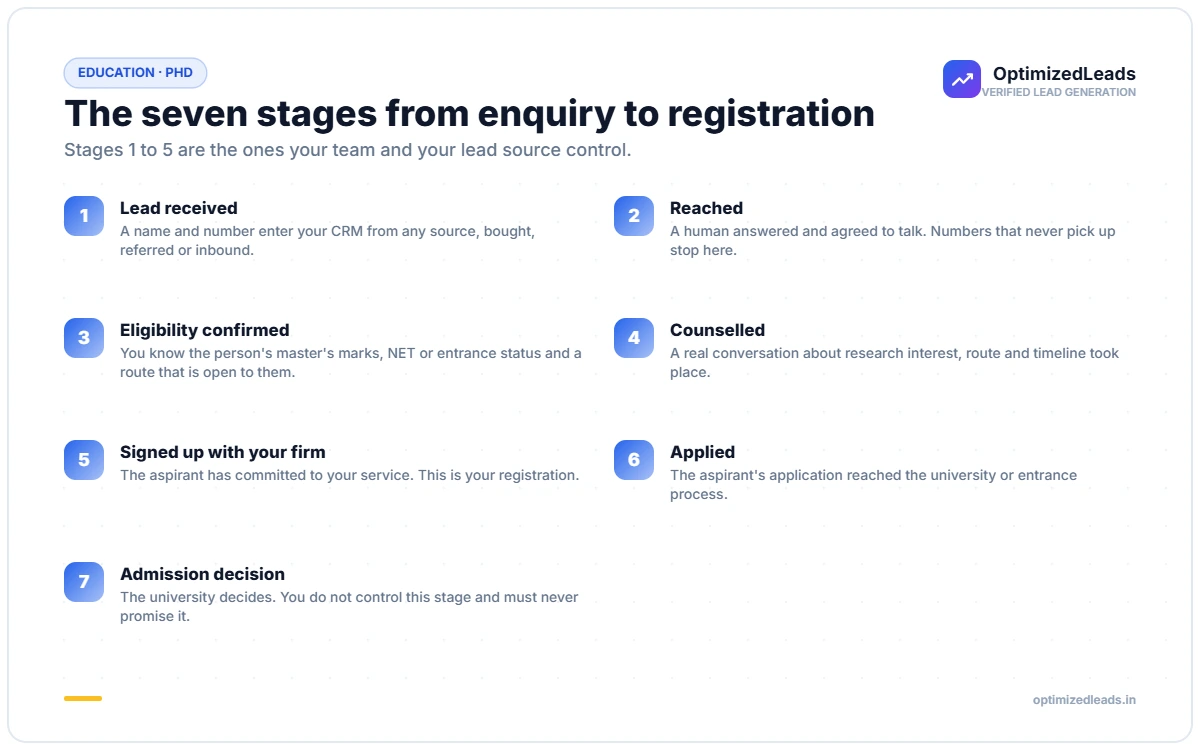
Not every firm uses all seven, and some add a step, but this sequence follows how doctoral admission actually runs under the UGC rules and gives each stage something you can count.
- Lead received. A name and number enter your CRM from any source, bought, referred or inbound.
- Reached. A human answered and agreed to talk. Numbers that never pick up stop here.
- Eligibility confirmed. You know the person's master's marks, NET or entrance status and a route that is open to them.
- Counselled. A real conversation about research interest, route and timeline took place.
- Signed up with your firm. The aspirant has committed to your service. This is your registration.
- Applied. The aspirant's application reached the university or entrance process.
- Admission decision. The university decides. You do not control this stage and must never promise it.
Stages 1 to 5 are the ones your team and your lead source control. Stages 6 and 7 depend on the aspirant, the department and the university. A funnel that mixes the two makes counsellors look responsible for outcomes they cannot guarantee, and it invites the kind of pressure that leads to over-promising. Track stage 7, but do not set a counsellor target on it.
What the UGC rules mean for stage 3
Eligibility is the stage where PhD funnels differ most from other admissions. Under the UGC (Minimum Standards and Procedures for Award of Ph.D. Degree) Regulations, 2022, notified on 7 November 2022, a candidate generally needs a master's degree with at least 55% aggregate marks, with a 5% relaxation for specified reserved categories (UGC Regulations 2022, institutional copy of the Gazette text). Admission then runs through a national test such as NET or JRF followed by an interview, or through an entrance test conducted by the institution, with a 70% test and 30% interview weighting for entrance-based admission. Part-time candidates need an employer no-objection certificate.
That structure makes stage 3 a real filter, not a formality. A lead who has a bachelor's degree only, who is below the marks requirement, or who has no plan to clear NET or an entrance test is not an eligible lead yet, however sincere. Counting such a person as "reached and interested" inflates your top of funnel and hides the true leak. Define stage 3 in writing with your counsellors, using the regulations and the specific university's current prospectus, and treat rules that are in flux with care. This is not legal advice; verify with the UGC and the university concerned.
The article on intent and eligibility signals goes deeper on telling a real enquiry from a curious click, and a lead quality scorecard turns the same definitions into a repeatable check.
The reverse formula: from target to lead requirement
Most owners compute the funnel forwards: we got this many leads, so we should get roughly that many registrations. The more useful direction is backwards. Start with the registrations you need and divide by each stage's pass rate.
Leads needed = target registrations / (reach rate x eligibility rate x counselling rate x sign-up rate).
Each rate is the share of the previous stage that passes into the next. Illustrative, replace with your numbers: suppose over a quarter your CRM shows a reach rate of 60%, eligibility confirmed for 50% of those reached, a counselling conversation for 70% of the eligible, and a sign-up from 40% of the counselled. These are round placeholders, not market figures. Multiply: 0.6 x 0.5 x 0.7 x 0.4 = 0.084. To sign up ten clients you would need roughly ten divided by 0.084, or about 119 leads.
Now see what the formula tells you. If you lift the reach rate from 60% to 70% through better timing and a cleaner source, the product becomes 0.098 and the same ten registrations need about 102 leads, roughly seventeen fewer. If instead you tried to push the sign-up rate from 40% to 50% by scripting harder, you would get a similar gain but at a risk of pressure tactics. The stage with the most room is not always the one the sales head wants to coach.
The same arithmetic produces your cost per signed-up client once you know what a lead and a counsellor-hour cost you. The article on cost per registration versus cost per lead picks up from here.
What to measure at each stage
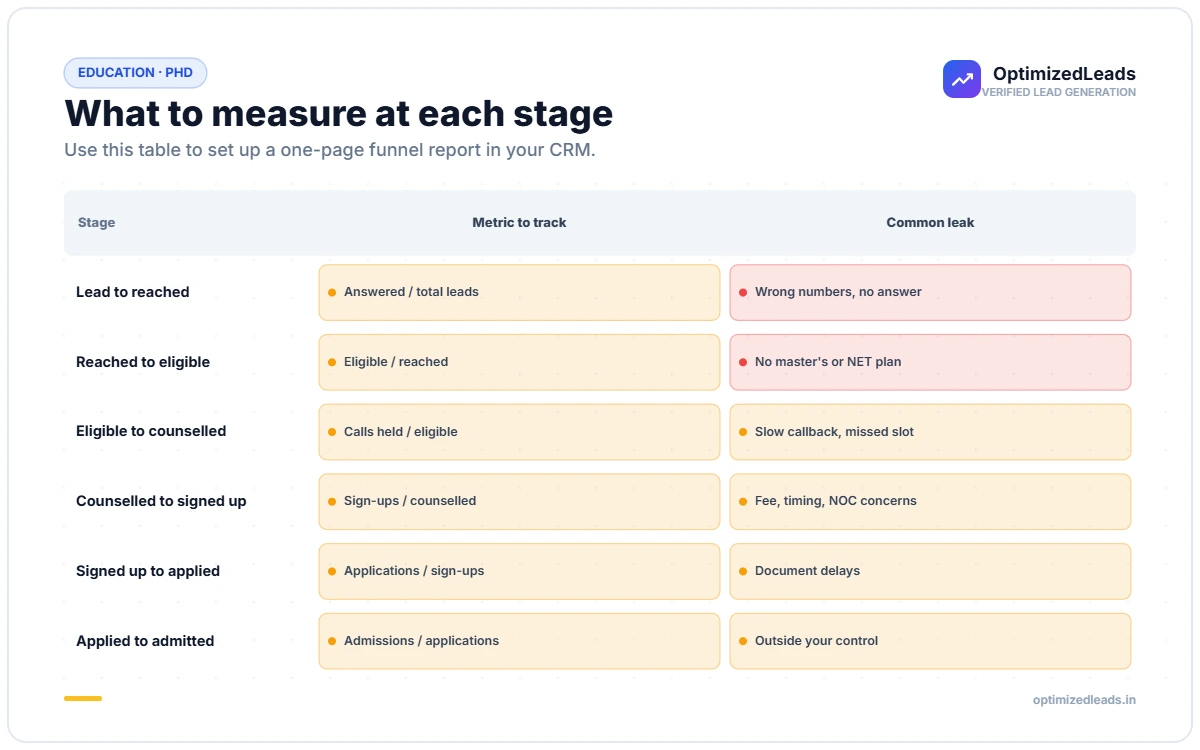
Use this table to set up a one-page funnel report in your CRM. The "typical leak" column lists where firms commonly lose people, to be checked against your own data rather than assumed.
| Stage | Metric to track | Common leak |
|---|---|---|
| Lead to reached | Answered / total leads | Wrong numbers, no answer |
| Reached to eligible | Eligible / reached | No master's or NET plan |
| Eligible to counselled | Calls held / eligible | Slow callback, missed slot |
| Counselled to signed up | Sign-ups / counselled | Fee, timing, NOC concerns |
| Signed up to applied | Applications / sign-ups | Document delays |
| Applied to admitted | Admissions / applications | Outside your control |
Cut each metric by source, by counsellor and by month of lead arrival. The cut by source is the one that settles arguments with agencies and suppliers: if one source shows a low reach rate and another a low eligibility rate, you know which conversation to have with each. A follow-up cadence mostly lifts the second and third rows, while the source decides the first two.
Timing: why a monthly funnel lies
PhD admission is slow, and slow processes break monthly reporting. Take the DAVV Indore example documented in its brochure and a university notice: applications ran from 14 to 30 November 2025, the entrance test was held on 21 December 2025, and a provisional PhD admission list for one institute was dated 30 January 2026, roughly eleven weeks from the opening of applications (DAVV information brochure). A lead that arrives in October may be a sign-up in November, an application in December and an admission in February. If you compare February's admissions with February's leads you are comparing different people.
The fix is cohort reporting. Group leads by the month they arrived and follow each group through the stages as the cycle plays out. Keep stages 1 to 5 on a short window, because they happen within days or weeks, and stage 7 on a long one. Two cohorts with the same lead count can have very different outcomes depending on whether they arrived before an application window or just after it closed. Cycles also change year to year: DAVV's registration opened in September in 2023 and in November in 2025, so last year's dates are a poor guide to this year's.
How the funnel looks in Indore and tier-2 cities
Local data is sparse, so keep claims modest. For Indore, the verifiable pieces are about the university cycle rather than the aspirant. DAVV's December 2025 brochure shows entrance-test admission in 13 subjects, while about 30 other subjects, including commerce, management, education and law, admitted through valid NET, JRF or CSIR scores. That means your eligibility stage in Indore splits into two different conversations: one about preparing for an entrance test, one about holding or earning a NET score. Track them as separate sub-funnels.
Applicant volume also swings. A 2023 report in the Free Press Journal said DAVV had about 1,300 applications for 450 seats across 38 disciplines after 20 days of registration, against 6,257 applicants for 1,215 seats the previous year, with the reason for the fall not stated (Free Press Journal). That was a partial window at one university, so do not extrapolate from it. The practical lesson is that applicant demand is not constant, which is another reason to recompute your funnel each cycle rather than carry a rate forward.
Working professionals and faculty are a natural segment for tier-2 firms, because the part-time route exists under the regulations, but no verified data tells us how large that segment is in Indore. Add a "part-time, NOC needed" tag in your CRM and let your own numbers answer.
Where bought leads change the arithmetic
Funnel maths is also how you judge any outside source fairly. Ask a supplier of leads for nothing you cannot measure yourself: run their leads through the same stages and compare reach, eligibility and counselling rates with your other sources. OptimizedLeads supplies ready PhD admission leads on a plan, works from existing data, comes with a free CRM so the stages are tracked from day one, and replaces invalid leads on terms agreed in writing. It makes no claim about your sign-up rate, and you should treat any supplier that does with caution. See the pricing page for current plans and confirm what counts as invalid before you start.
A fair test is to run a small batch alongside your current source for a cycle and compare stage by stage. The article on cost per qualified eligibility conversation shows how to put a rupee figure on stage 3 so the two sources can be compared on the same footing. The funnel does not care who sent the lead, only what happened next.
What to do this week
- Write down your own definition of each of the seven stages and of the word "registration".
- Export the last quarter of leads from your CRM or sheet and fill in a count for each stage.
- Compute each stage's pass rate and multiply them to get your current end-to-end rate.
- Apply the reverse formula to next quarter's target and check whether your lead supply is enough.
- Pick the single weakest stage and make one change to it this month.
- If you want to compare a second source, start the free 2-day trial and read about how PhD admission leads are supplied.
Sources and further reading
- UGC Regulations 2022 (institutional copy of the Gazette) - eligibility, admission routes, 70:30 weighting, part-time NOC.
- DAVV information brochure - December 2025 cycle dates and admission routes by subject.
- Free Press Journal - 2023 DAVV application figures, partial window.
Rules change; verify with the UGC and the relevant university. Not legal advice.
Frequently Asked Questions
What is a good lead-to-registration rate for a PhD guidance firm?
No credible published benchmark exists, so any single number you read is a guess. Compute your own rate from CRM history, stage by stage, and use it to plan next quarter.
How many leads do I need to get ten PhD registrations?
Divide ten by the product of your reach, eligibility, counselling and sign-up rates. With round placeholder rates of 60%, 50%, 70% and 40% that comes to about 119 leads, but replace those placeholders with your own figures.
Should counsellors be given targets on PhD admissions?
Set targets on the stages you control, such as reach, eligibility screening, counselling held and sign-ups, and track admission outcomes without a counsellor target. Universities decide admission, and a target on it invites over-promising.
Why does my monthly funnel report look inconsistent?
PhD admission cycles span weeks or months, so leads arriving in one month convert in another. Report by cohort of arrival month instead of by calendar month to compare like with like.
How should I compare a lead provider with my own ads?
Run the same stage definitions on both sources for a full cycle and compare reach, eligibility and counselling rates. Ask the provider for its invalid-lead definition and replacement terms in writing before you start.
Want a second lead source to run through your own funnel? Begin the free 2-day trial and see how ready PhD admission leads behave at each stage.